
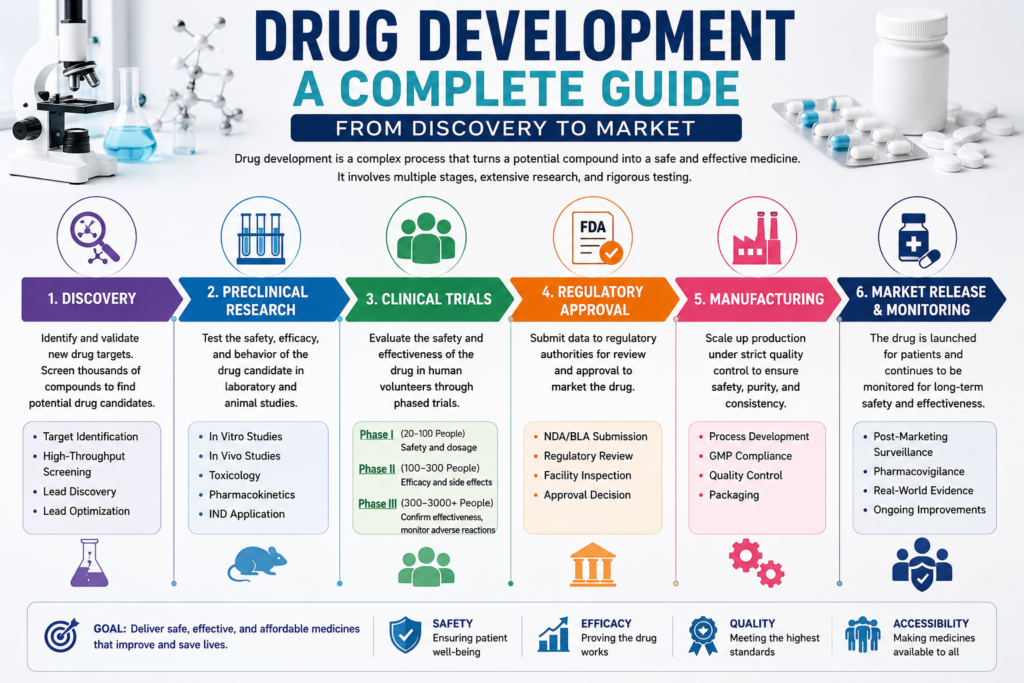
Developing a new medicine is one of the most complex and rewarding processes in healthcare. Every life-saving drug available today has gone through years of scientific research, rigorous testing, and strict regulatory review before reaching patients.
The drug development process is designed to ensure that medicines are safe, effective, and manufactured to the highest quality standards. Although the journey is long and expensive, it plays a vital role in improving patient care and treating diseases that once had limited or no treatment options.
In today’s rapidly evolving pharmaceutical industry, innovations such as artificial intelligence, precision medicine, and advanced biotechnology are making drug development faster and more efficient than ever before.
In this guide, we’ll explore each stage of the drug development process, explain why it matters, and highlight the challenges and innovations shaping the future of medicine.
What Is Drug Development?
Drug development is the process of transforming a promising scientific discovery into a safe and effective medicine that can be prescribed to patients.
It involves multiple stages, including laboratory research, preclinical testing, clinical trials, regulatory approval, manufacturing, and post-market monitoring.
While drug discovery focuses on identifying potential compounds, drug development ensures those compounds become approved medicines through scientific validation and regulatory compliance.
The primary goals of drug development include:
- Discovering safe treatment options
- Improving patient outcomes
- Reducing disease burden
- Ensuring medicine quality
- Meeting global regulatory standards
The Drug Development Process: Key Stages
Although each drug follows a unique path, the development process generally includes several essential stages.
| Stage | Purpose | Average Duration |
| Drug Discovery | Identify promising compounds | 2–5 years |
| Preclinical Development | Evaluate safety in laboratories and animals | 1–2 years |
| Clinical Trials | Test safety and effectiveness in humans | 6–7 years |
| Regulatory Review | Obtain approval from health authorities | 1–2 years |
| Manufacturing & Monitoring | Produce and monitor medicine after launch | Ongoing |
The entire journey may take 10–15 years, with only a small percentage of drug candidates eventually receiving approval.
Stage 1: Drug Discovery
Drug discovery is where every successful medicine begins.
Researchers first identify the biological cause of a disease and then search for compounds capable of modifying or blocking that disease process.
Scientists may evaluate thousands—or even millions—of molecules before identifying a few promising candidates.
Activities during drug discovery include:
- Identifying disease targets
- Understanding disease biology
- Screening chemical compounds
- Lead compound identification
- Molecular optimization
- Laboratory experiments
Modern technologies have dramatically improved this stage.
Artificial intelligence, machine learning, and computational chemistry now help researchers identify potential drug candidates more quickly than traditional methods.
Why drug discovery matters
Finding the right molecule is essential because it determines the future success of the entire development program.
A strong candidate should:
- Show therapeutic potential
- Demonstrate acceptable safety
- Be chemically stable
- Be suitable for manufacturing
- Offer advantages over existing treatments
Even with advanced technologies, most compounds never progress beyond this stage.
Stage 2: Preclinical Development
Once a promising compound has been identified, researchers begin preclinical development.
The objective is to determine whether the candidate is safe enough to be tested in humans.
Preclinical studies are performed using laboratory models and, where required by regulations, animal studies to evaluate the compound’s safety profile.
Researchers collect important information such as:
- Toxicity
- Pharmacology
- Pharmacokinetics (how the body processes the drug)
- Pharmacodynamics (how the drug affects the body)
- Potential side effects
- Appropriate dosage ranges
These studies help scientists understand whether the potential benefits outweigh the possible risks.
Why Preclinical Testing Is Important
Skipping safety evaluations could expose patients to unnecessary risks.
Preclinical research helps researchers answer important questions such as:
- Is the drug toxic?
- How is it absorbed?
- How long does it stay in the body?
- Which organs are affected?
- What dosage appears safest?
Only candidates demonstrating acceptable safety profiles move into human clinical trials.
Common Challenges During Drug Development
Drug development is a high-risk process, and many promising compounds fail before reaching patients.
Some common challenges include:
- High research costs
- Long development timelines
- Unexpected safety concerns
- Manufacturing difficulties
- Regulatory compliance requirements
- Limited effectiveness in testing
In fact, only a small fraction of compounds entering development ultimately receive regulatory approval.
. For this reason, throughout the process, pharmaceutical corporations make significant investments in scientific innovation, quality control, and research.
Factors That Influence Drug Development Success
Several elements contribute to a successful drug development program.
These include:
- Strong scientific evidence
- Robust clinical study design
- Effective collaboration among researchers
- Regulatory expertise
- Advanced manufacturing capabilities
- Continuous quality management
Organizations that integrate these factors are better positioned to bring innovative therapies to patients while maintaining safety and compliance.
Key Takeaways
- Drug development transforms scientific discoveries into approved medicines.
- The process typically takes 10–15 years.
- Drug discovery identifies promising compounds.
- Preclinical studies evaluate safety before human testing.
- Most drug candidates do not reach the market due to strict safety and efficacy requirements.
- Scientific innovation continues to improve the efficiency of pharmaceutical research.
Drug Development: A Complete Guide from Discovery to Market (Part 2)
Stage 3: Clinical Trials
Once a drug successfully passes preclinical testing, it enters clinical trials. This stage involves testing the medicine in human volunteers to evaluate its safety, effectiveness, and optimal dosage.
Clinical trials are conducted in four phases, with each phase answering specific scientific and regulatory questions.
Phase I: Safety and Dosage
Phase I trials involve a small group of healthy volunteers or, in some cases, patients.
The main objective is to understand how the drug behaves in the human body and identify any immediate side effects.
Key objectives include:
- Evaluate safety
- Determine a safe dosage range
- Study drug absorption and metabolism
- Monitor early side effects
Phase II: Effectiveness
If the drug demonstrates an acceptable safety profile, it moves into Phase II trials.
This phase includes a larger group of patients who have the target disease.
Researchers evaluate whether the medicine produces the intended therapeutic effect while continuing to monitor safety.
Researchers focus on:
- Treatment effectiveness
- Dose optimization
- Short-term safety
- Common side effects
Phase III: Large-Scale Evaluation
Phase III is the largest and most comprehensive clinical trial stage.
Thousands of patients across multiple hospitals and countries may participate.
Researchers compare the new medicine with existing treatments or a placebo to confirm its effectiveness and overall safety.
This phase provides the evidence required for regulatory approval.
Phase IV: Post-Marketing Surveillance
Clinical evaluation doesn’t stop after approval.
Once a medicine reaches the market, pharmaceutical companies continue monitoring its long-term performance.
This is known as Phase IV or post-marketing surveillance.
It helps identify rare side effects that may only appear after the drug is used by a large population.
Phase IV focuses on:
- Long-term safety
- Real-world effectiveness
- Rare adverse reactions
- New therapeutic uses
Clinical Trial Phases at a Glance
| Phase | Participants | Primary Goal |
| Phase I | 20–100 | Safety and dosage |
| Phase II | 100–300 | Effectiveness and side effects |
| Phase III | 1,000–3,000+ | Confirm safety and efficacy |
| Phase IV | General population | Long-term monitoring |
Regulatory Approval
After successful clinical trials, pharmaceutical companies submit a comprehensive application to regulatory authorities for review.
Regulators carefully evaluate all scientific data before deciding whether the medicine should be approved.
Major regulatory agencies include:
- U.S. Food and Drug Administration (FDA)
- European Medicines Agency (EMA)
- Central Drugs Standard Control Organisation (CDSCO) in India
- Medicines and Healthcare products Regulatory Agency (MHRA)
The review typically includes:
- Clinical trial data
- Manufacturing quality
- Safety reports
- Risk-benefit analysis
- Product labeling
Only medicines meeting strict quality, safety, and efficacy standards receive approval.
Pharmaceutical Manufacturing
Regulatory approval is only one part of the journey.
The medicine must also be manufactured consistently while maintaining high-quality standards.
Manufacturing follows Good Manufacturing Practices (GMP) to ensure every batch meets regulatory requirements.
Key manufacturing activities include:
- Raw material testing
- Process validation
- Sterility assurance
- Quality control testing
- Packaging and labeling
- Product distribution
Reliable manufacturing helps ensure patients receive safe and effective medicines every time.
Challenges in Drug Development
Drug development remains one of the most challenging scientific processes.
Even promising drug candidates may fail due to safety concerns, lack of effectiveness, or manufacturing difficulties.
Common challenges include:
- High research and development costs
- Long development timelines
- Clinical trial failures
- Regulatory complexity
- Patient recruitment issues
- Manufacturing scalability
- Intellectual property protection
These challenges highlight the importance of strategic planning, scientific expertise, and regulatory compliance.
Emerging Trends in Drug Development
The pharmaceutical industry continues to evolve through technological innovation.
Several emerging trends are transforming how new medicines are discovered and developed.
Artificial Intelligence (AI)
AI helps researchers analyze large datasets, predict promising drug candidates, and accelerate drug discovery.
Personalized Medicine
Modern therapies are increasingly tailored to an individual’s genetic profile, improving treatment effectiveness and reducing unwanted side effects.
Gene and Cell Therapy
Gene editing and cell-based therapies are opening new possibilities for treating inherited disorders, cancers, and rare diseases.
Digital Clinical Trials
Digital technologies, wearable devices, and remote patient monitoring improve data collection and enhance participant engagement.
Biologics and Biosimilars
Biological medicines are becoming increasingly important for treating chronic diseases, autoimmune disorders, and cancers.
Why Drug Development Matters
Drug development is more than a scientific process—it directly impacts global health.
Every successful medicine has the potential to improve quality of life, extend life expectancy, and address unmet medical needs.
Its benefits include:
- Better patient outcomes
- More effective disease management
- Reduced healthcare burden
- Improved quality of life
- Continuous medical innovation
- Stronger public health systems
Without ongoing pharmaceutical research, many life-saving treatments available today would not exist.
The Future of Drug Development
The future of drug development is expected to become faster, smarter, and more patient-focused.
Innovations in artificial intelligence, automation, genomics, and digital health are helping researchers make more informed decisions throughout the development process.
Future priorities include:
- Faster drug discovery
- Precision medicine
- Sustainable manufacturing
- Advanced biologics
- AI-assisted clinical trials
- Global collaboration
- Data-driven research
These advancements have the potential to reduce development timelines while maintaining the highest standards of safety and quality.
Conclusion
Drug development is a complex yet essential process that transforms scientific discoveries into life-changing medicines. From identifying promising compounds and conducting preclinical research to clinical trials, regulatory approval, and commercial manufacturing, every stage is designed to ensure patient safety and therapeutic effectiveness.
Although the journey often takes more than a decade and requires significant investment, it remains the foundation of pharmaceutical innovation. Advances in artificial intelligence, precision medicine, and biotechnology are reshaping the future of drug development, enabling researchers to develop treatments more efficiently and address previously unmet medical needs.
As healthcare continues to evolve, the commitment to scientific excellence, regulatory compliance, and patient-centered innovation will remain at the heart of successful drug development.
Frequently Asked Questions (FAQs)
1. How long does drug development take?
Developing a new medicine typically takes 10–15 years, including discovery, preclinical studies, clinical trials, and regulatory approval.
2. What are the main stages of drug development?
The key stages are drug discovery, preclinical development, clinical trials, regulatory review, manufacturing, and post-marketing surveillance.
3. Why are clinical trials important?
Clinical trials evaluate a medicine’s safety, effectiveness, dosage, and potential side effects before it can be approved for public use.
4. Why do many drug candidates fail?
Many candidates fail because they do not demonstrate sufficient safety, effectiveness, or manufacturing feasibility during testing.
5. What is the role of regulatory agencies?
Regulatory authorities review scientific evidence to ensure that medicines meet established standards for quality, safety, and efficacy before approval.